Showing posts with label Pele. Show all posts

Sunday, June 18, 2017

World Cup - Mexico 1970


The 1970 finals were the first to be broadcast live in colour and they're rightfully remembered for the champions Brazil's kaleidoscope of 19 goals from 6 games - including the four in the final against Italy, into the L supports at the Estadio Azteca in Mexico City...


.
.. and 15 goals in their five games at the Estadio Jalisco in Guadalajara - 16 if this one had gone in!


17 if this one had gone in!


Friday, May 9, 2014

Sao Paulo FC - Brasileiro 2014


The Tricolor have played two home games this season, one at Morumbi, the other at Pacaembu.

The goal nets at either could easily be transplanted back in time to Mexico 86 and nobody would notice the difference.

Morumbi


Pacaembu


The goal nets at both were once classic Brazilian L-supports.

Morumbi


Pacaembu


Saturday, April 26, 2014

Fluminense FC - Brasileiro 2014


With FIFA World Cup 2014 almost upon us, The History of Goalnets celebrates the start of the new Brazilian Serie A season by visiting the Serie A stadia and checking out the on-field architecture at each.

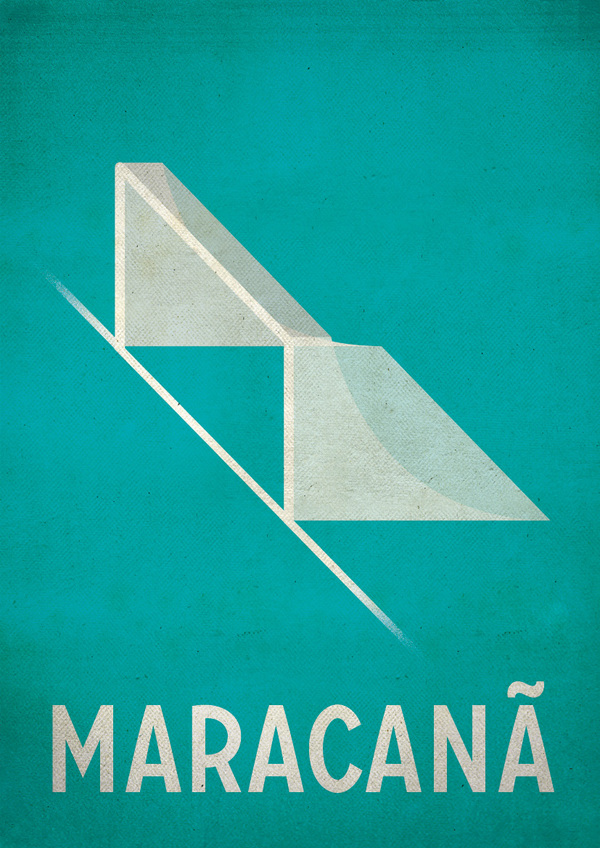
Until recently, Brazil was one of the only countries left in world football which rebelled against this era of uniform and homogenous box-nets,  and where the native system deployed to support the nets - L-supports, in Brazil's case - could still be seen.

As the World Cup has crept closer, and the focus of the game's global policeman FIFA has sharpened, so the native L-supports have largely been replaced. But not all...

When the World Cup final is played at Estadio do Maracana on 13 July, you can be sure the nets will be firmly tied back and hang like square tents that can't be differentiated from those in Munich 1974, Mexico City 1986, and the last four, utterly uniform, World Cup finals.

However, when Fluminense kicked off their 2014 season at Maracana last weekend, the nets were hanging in the shape of L-supports. OK, the hardware has been shorn of the actual L-supports, so the nets are still tied to stanchions, like box nets. Interestingly the ground staff have chosen to tie the nets so they're shaped like classic L-supports.


Might this be because of complaints during last year's Confederations Cup that the nets at the renovated Maracana had been changed and the spirit of the old stadium lost?

Sunday, December 8, 2013

A-list A-frames - Plymouth Argyle FC


The Pilgrims have a long history of distinctive on-field hardware.

Standard A-frames suited the early 60's


While something more boxy (or more Manchester City) were thought to be required for the 70's and the visit of Pele


The boxy white stanchions were eventually replaced by distinctive black hardware that served Home Park from the mid-90's to stadium redevelopment (and boxnets) in 2002.


Check out the old film clip below, where the ground staff are filmed erecting the cross bar, beautiful.


Sunday, November 10, 2013

101 Great Goals - Carlos Alberto


I've posted this goal in a previous context 18 months ago, but couldn't better the sentiment today.

So I post in full below, for the 101 Great Goals series.

Forget the melina and the elaborate build-up play against an Italy side exhausted and in disarray after the controversial late introduction of Gianni Rivera; the goal that symbolises the greatest team in history begins with Pele.

From there you'll see this famous goal described in terms of Pele's pass and Carlos Alberto's shot, as though this was a goal of two movements - pass / shot - when in fact, it has three movements - pass / shot / net.

Carlos Alberto's shot is often described as a thunderbolt or cannonball, where a firework might be a better metaphor:

Pele lights the fuse (first movement) - and stands well back - and the ball shoots from Carlos Alberto's boot like a rocket (second movement).

But rockets can be duds, can shoot into the night sky and fail to explode. At which times, two movements is insufficient and the sense of disappointment is palpable.

The last goal scored in the 1970 World Cup, the goal that came to symbolise the greatest team in history is no disappointment. Carlos Alberto's shot is no dud. It's aim is true.

But only when the ball hits the back of the net - and the net explodes (third movement) - does the celebration truly begin.

You'll have seen this goal hundreds of times - it's one of the most famous goals ever scored - but look at it now with fresh eyes and ask, two movements or three?


Saturday, November 2, 2013

101 Great Goals - Gerd Muller


In the same way the Italian narrative of the 1970 World Cup final has been lost to the Brazilian fairytale, so has Gerd Muller's second goal in the Game of the Century played 4 days earlier, been lost to the story of Gianni Rivera.

Famously, Rivera - nicknamed Abatino for his clean and proper attacking style - couldn't be trusted by coach Valcareggi to track back, so played only 45 minutes in each game as part of a Staffeta, or relay, in tandem with Sandro Mazzola.

Valcareggi's worst fears were realised at the Muller goal, which was West Germany's equaliser for 3-3. Finding himself minding the near post at the set piece, Rivera let Muller's soft, if well directed, header pass between himself and the post, and into the net.  Rivera's reasoning to the screaming Italian goalkeeper Enrico Albertosi? He didn't know how to defend the post, so did nothing.

The narrative of this goal was quickly erased as Rivera scored Italy's 4-3 winner less than 60 seconds later, but I've always loved this goal, the way the ball rolls crazily up and round the seam of the Azteca net while Albertosi rolls his eyes in despair at the same Gianni Rivera.


Thursday, June 13, 2013

Estádio Nacional Mané Garrincha - World Cup 2014 Venue


With bent legs and the air of a man playing simply for the joy of playing, Manuel Francisco dos Santos - called a wren, or garrincha by his big sister - is the mazy dribbling embodiment of diversity over conformity, of the individual over the team, of what Brazilians call futebol arte. 


Following Garrincha's retirement the CBF named the Estadio Nacional in Brasilia after him and, out of respect to the nation's most Brazilian of players, hung the goal nets from Brazilian L-supports.


However the old stadium has been replaced by a shiny new one for the 2014 World Cup, and the Brazilian L-supports have disappointingly been replaced by box-nets.

The famous Brazilian playwright Nelson Rodrigues wrote, "He is considered a retard but Garrincha proved in the (1958) World Cup that we are the retarded ones - because we think, we rationalise."

Yet no thought has gone into junking Brazilian heritage by installing uniform box-nets in the stadium named after Brazil's most diverse player and there's no rational reason Brazil can't celebrate it's own World Cup between goal nets suspended in the traditional Brazilian way.


Thursday, June 6, 2013

The Campaign


If you support diversity and individual identity in the game, and if you're tired of football everywhere looking the same, PLEASE SIGN OUR PETITION.

You think FIFA won't budge? You think you can't make a difference?

As Rangers Tax Case wrote in the Guardian:

"Why bother? What can I do?" 

If it is something you care about, you can do anything you want.

Saturday, May 19, 2012

Iconic Goals - Carlos Alberto

How the goal nets helped frame the most famous goals ever scored


Forget the melina and the elaborate build-up play against an Italy side exhausted and in disarray after the controversial late introduction of Gianni Rivera; the goal that symbolises the greatest team in history begins with Pele.

From there you'll see this famous goal described in terms of Pele's pass and Carlos Alberto's shot, as though this was a goal of two movements - pass / shot - when in fact, it has three movements - pass / shot / net.

Carlos Alberto's shot is often described as a thunderbolt or cannonball, where a firework might be a better metaphor:

Pele lights the fuse (first movement) - and stands well back - and the ball shoots from Carlos Alberto's boot like a rocket (second movement).

But rockets can be duds, can shoot into the night sky and fail to explode. At which times, two movements is insufficient and the sense of disappointment is palpable.

The last goal scored in the 1970 World Cup, the goal that came to symbolise the greatest team in history is no disappointment. Carlos Alberto's shot is no dud. It's aim is true.

But only when the ball hits the back of the net - and the net explodes (third movement) - does the celebration truly begin.

You'll have seen this goal hundreds of times - it's one of the most famous goals ever scored - but look at it now with fresh eyes and ask, two movements or three?